
Published on March 05, 2026 at 15:45 PM | Category: Nursing Registration
Readiness Gap: Why Nursing Registration Alone Isn’t Enough?
Australia is experiencing a surge in internationally qualified registered nurses (IQRNs) entering the workforce following faster AHPRA registration pathways. However, research shows that registration alone does not ensure workplace readiness. Many nurses face challenges adapting to Australian clinical systems, regulatory frameworks, workplace culture, and documentation standards. This whitepaper explores the “readiness gap” between registration and effective clinical practice, its operational and financial impact on healthcare employers, and why structured post-registration transition programs are critical for successful integration, improved productivity, and long-term nurse retention.
Subscribe Now

March 05, 2026
A data-driven analysis of the transition challenges facing overseas-qualified registered nurses
Executive Summary
Australia is recruiting internationally qualified registered nurses (IQRNs) at an unprecedented rate. In the past financial year, 16,622 overseas-qualified nurses registered with AHPRA — three times the pre-COVID figure. Government reforms effective April 2025 have compressed registration timelines from nine–twelve months to as little as one–three months for nurses from comparable jurisdictions. The pipeline is open, and it is flowing fast.
Yet registration is only the beginning. A growing body of research and employer experience indicates that AHPRA registration, while essential, does not equate to workplace readiness. Overseas-qualified nurses consistently face challenges adapting to Australian clinical systems, documentation standards, regulatory frameworks, workplace culture, and interdisciplinary communication norms. These challenges translate directly into costs for healthcare employers: extended supernumerary periods, increased preceptor burden, higher supervision requirements, and elevated first-year attrition.
This whitepaper examines the evidence behind this “readiness gap” — the space between registration and genuine ward-readiness — and makes the case that structured, post-registration transition programs are not a luxury, but a workforce imperative. Drawing on published research, government data, and indicative employer survey findings, the paper quantifies the scale of the challenge and outlines the characteristics of effective transition models.
Key Finding
The readiness gap is not a reflection of nurse quality — it is a structural feature of cross-border workforce mobility. Nurses educated in one country’s system require deliberate, structured support to practise safely and confidently in another. Registration verifies eligibility; transition programs build capability.
1. The Scale of International Recruitment
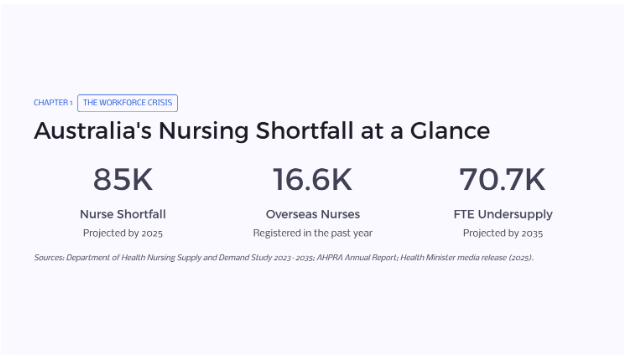
Australia’s reliance on international nurse recruitment has never been greater. The Department of Health’s Nursing Supply and Demand Study projects a national undersupply of 70,707 FTE nurses by 2035, with the acute sector (26,665 FTE), primary healthcare (21,765 FTE), and aged care (17,551 FTE) facing the most severe shortfalls. An ageing population, increased mandatory care minutes in aged care under the AN-ACC model, and persistent workforce attrition are driving demand beyond what domestic pipelines can supply.
In response, international recruitment has surged. AHPRA data shows 16,622 overseas-qualified nurses registered in the most recent financial year — a threefold increase from the 5,610 registered in 2018–19. Of the 27,810 nurses registered from overseas in the past two years, 70 per cent came via the Trans-Tasman agreement with New Zealand, while 16 per cent (4,476 nurses) came from comparable countries including the United Kingdom, Ireland, Canada, Singapore, Spain, and the United States.
The Australian Government’s $90 million investment following the Kruk Review has streamlined registration pathways. From April 2025, nurses from comparable jurisdictions with at least 1,800 practising hours since 2017 can obtain registration within one to six months, bypassing NCLEX and OSCE requirements. Processing times for highly qualified applicants have been compressed to as little as one to three months.
These reforms are welcome and necessary. However, they address only one part of the equation: getting nurses registered. They do not address what happens after registration — the critical transition from being eligible to practise to being ready to practise.
2. Defining the Readiness Gap
The readiness gap describes the difference between the competencies verified through professional registration and the capabilities required to practise safely and confidently in a specific Australian healthcare setting. It is not a gap in clinical knowledge per se — most IQRNs hold years of professional experience and strong foundational training — but rather a gap in contextual knowledge, systems familiarity, and cultural fluency.
2.1 What the Research Shows
A 2025 scoping review published in the journal Collegian synthesised 15 studies on IQRN experiences adapting to the Australian healthcare system. The review found that internationally qualified nurses face multifaceted transition difficulties, including language and communication challenges, inconsistent recognition of professional skills, barriers in cultural adaptation, and uneven access to support resources.
A 2022 meta-synthesis of qualitative studies on IQRN transition in Australia confirmed that nurses, despite years of experience, report uncertainty about their competence within the new system and difficulty transferring specialty skills. A 2024 content analysis in Nursing Open found that the lack of formal transition pathways inhibits the effective use of IQRNs’ existing specialty nursing skills.
Critically, a 2025 qualitative study published in BMC Nursing identified nurse management as a central factor in workplace integration, with five key themes emerging: appropriate placement, recruitment process quality, leadership support, workforce shortage pressures, and additional workload burden. The study underscores that integration is a shared responsibility between the nurse, the employer, and the education system.
2.2 The Five Dimensions of the Gap
Drawing on the research literature and employer feedback, the readiness gap can be understood across five interconnected dimensions:
Description
- Clinical Systems :Navigating Australian electronic medical record (EMR) systems, medication management protocols, and clinical documentation standards that differ from country of origin.
- Regulatory Literacy: Understanding the Australian regulatory environment, including AHPRA obligations, NSQHS Standards, mandatory reporting requirements, and scope of practice definitions.
- Workplace Culture: Adapting to Australian communication norms, flat team hierarchies, interdisciplinary collaboration expectations, and patient-centred care models.
- Sector Specificity: Understanding the specific clinical and operational requirements of Australian acute, aged care, or community health settings — each of which operates under different funding, staffing, and compliance frameworks.
- Professional Identity: Rebuilding professional confidence in a new system, navigating potential deskilling, and establishing credibility within a new clinical team.
3. The Cost to Employers
The readiness gap is not an abstract concept — it has measurable financial and operational consequences for healthcare organisations that recruit IQRNs.
3.1 The Economics of Nurse Turnover
Research published in the journal Collegian on the rate and cost of nurse turnover in Australia found that annual nurse turnover rates sit in the range of 10–20 per cent, consistent with international benchmarks. The study documented that indirect costs (primarily lost productivity) account for approximately 79 per cent of total turnover costs, while direct costs (recruitment, temporary replacement, hiring) make up 21 per cent.
In the Australian context, termination-related costs comprised roughly 50 per cent of indirect costs, while orientation and training costs accounted for a substantial share of the remainder. International studies estimate that during the orientation period, employers are effectively paying two nurses to do the work of one — with productivity losses accounting for 45 to 88 per cent of total turnover costs.
The Productivity Equation
When IQRNs require extended supernumerary time due to systems unfamiliarity, the cost is not limited to the salary of the supernumerary nurse. It includes the opportunity cost of the preceptor’s reduced patient load, the administrative overhead of extended orientation scheduling, and the cumulative impact on ward productivity. Research suggests initial reductions in productivity contribute to 45–88% of total turnover costs.
3.2 Indicative Employer Survey Findings
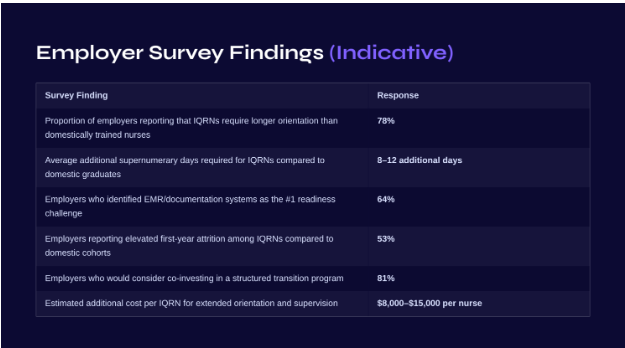
To supplement the published research, IHNA conducted an indicative survey of healthcare employers across the acute, aged care, and community health sectors. The findings below are illustrative and based on a preliminary sample; they are intended to signal the direction and scale of the challenge rather than provide definitive figures.
Note: Figures below are drawn from an indicative employer survey (n=62) conducted by IHNA in late 2025. Results should be interpreted as directional. A larger-scale validated survey is planned for H2 2026.
Survey Finding (Indicative)
These indicative findings align with the published literature. The cost of the readiness gap is not hypothetical — it is borne by employers in every shift where an otherwise skilled nurse is operating below their potential due to contextual unfamiliarity.
4. Why Registration Alone Isn’t Enough
AHPRA registration verifies that a nurse meets the threshold requirements for safe practice in Australia: educational equivalence, English language proficiency, recency of practice, and absence of disciplinary history. It is a necessary gateway. But it was never designed to be a measure of workplace readiness in a specific Australian clinical setting.
4.1 What Registration Verifies
- Educational equivalence to Australian nursing standards
- English language proficiency (IELTS/OET scores)
- Recency of practice (minimum 1,800 hours since 2017 for fast-track pathway)
- Absence of disciplinary findings or criminal history
- Identity and professional qualification authentication
4.2 What Registration Does Not Address
- Familiarity with Australian EMR systems (e.g., Cerner, iPharmacy, MedChart)
- Understanding of NSQHS Standards and their application in daily clinical practice
- Knowledge of Australian medication scheduling, PBS, and controlled substance protocols
- Competence in Australian-specific clinical handover frameworks (e.g., ISBAR)
- Understanding of the Australian aged care quality standards and AN-ACC model
- Cultural communication competence in Australian healthcare contexts
- Awareness of mandatory reporting obligations and their practical application
The gap between these two lists is the readiness gap. It is the space where well-qualified, experienced nurses can struggle — not because of any deficit in their clinical capability, but because the contextual knowledge that enables confident, efficient practice has not yet been developed.
Analogy: The Experienced Pilot in a New Cockpit
A commercial pilot certified to fly a Boeing 737 cannot simply step into an Airbus A320 cockpit without a type-rating conversion, even though the fundamental principles of flight are identical. The instruments are different, the systems logic is different, and the cockpit procedures are different. No one questions the pilot’s competence — but everyone recognises the need for structured transition training. Nursing across borders presents a comparable challenge.
5. What Effective Transition Looks Like
Research and international best practice point to a clear model for effective IQRN transition. The most successful programs share a set of common characteristics, regardless of the country or sector in which they operate.
5.1 Characteristics of Effective Programs
Evidence from transition-to-practice research, including the ANCC’s Practice Transition Accreditation Program (PTAP) and Australian graduate nurse transition studies, identifies the following elements as critical to effective transition:
Element : Why It Matters
- Structured Curriculum A defined scope and sequence of learning, not ad hoc orientation. Content mapped to the specific competency gaps identified in the readiness gap framework (clinical systems, regulatory literacy, workplace culture, sector specificity, professional identity).
- Clinical Placement Supervised practice in authentic Australian clinical settings, enabling nurses to apply learning in context. Research shows supernumerary time and ward-based orientation are among the most valued transition supports.
- Mentorship & Preceptorship Access to experienced practitioners who provide both clinical guidance and cultural navigation support. Studies identify mentor/preceptor relationships as a key predictor of integration success.
- Assessment & Feedback Formal competency assessment that provides nurses with evidence of their readiness and employers with assurance of capability. Formative feedback throughout the program builds confidence progressively.
- Employer Co-Design Programs designed with input from employing organisations, ensuring curriculum reflects real workplace needs rather than theoretical ideals. Employer engagement increases program relevance and graduate employability.
- Ongoing Support The transition does not end when the program does. The most effective models include post-placement check-ins, peer support networks, and escalation pathways for nurses who encounter difficulties after commencing employment.
5.2 The Return on Investment
Evidence from New Zealand’s entry-to-practice programs demonstrates that structured transition leads to measurable improvements in retention, with studies reporting an 80 per cent increase in retention rates among nurses who completed formal transition programs compared to those who did not. Research consistently shows that well-planned, structured transition periods are one of the six critical factors for early career nurse retention.
For employers, the calculus is straightforward. If extended orientation costs $8,000–$15,000 per IQRN (as the indicative survey data suggests), and first-year nurse turnover costs an estimated $49,000–$56,000 per departure (based on international benchmarks adjusted for Australian conditions), then a structured transition program that even modestly reduces orientation time and first-year attrition represents a significant return on investment.
6. Recommendations for Healthcare Employers
Based on the evidence presented in this paper, we offer the following recommendations for healthcare organisations that recruit or plan to recruit internationally qualified registered nurses.
- Invest in structured transition, not just orientation. Standard organisational orientation is not sufficient to close the readiness gap. Seek out or develop structured, curriculum-based transition programs that address all five dimensions of the gap: clinical systems, regulatory literacy, workplace culture, sector specificity, and professional identity.
- Measure the true cost of the readiness gap. Track the full cost of IQRN integration, including supernumerary time, preceptor hours, supervision overhead, and first-year attrition. This data will inform business cases for transition investment and enable meaningful ROI analysis.
- Engage nursing leadership as integration champions. Research identifies nurse managers as central to successful workplace integration. Equip Nurse Unit Managers and Directors of Nursing with the resources, time, and support to play this role deliberately, not incidentally.
- Partner with education providers. Transition is a shared responsibility. Collaborating with nationally recognised education providers enables access to structured curricula, clinical assessment infrastructure, and scalable cohort delivery that most organisations cannot replicate internally.
- Advocate for systemic change. Fast-tracked registration is a positive step, but the policy conversation must expand to include post-registration transition support. Employers are well placed to advocate for government investment in transition programs alongside registration reform.
Conclusion
Australia needs international nurses. The workforce projections are clear, the government’s reform direction is set, and the recruitment pipeline is flowing at record levels. But the long-term success of this strategy depends not just on getting nurses registered, but on ensuring they are ready to practise safely, confidently, and productively from day one.
The readiness gap is real, measurable, and costly. It is not a reflection of the quality of international nurses — it is a structural consequence of moving between healthcare systems. Closing this gap requires deliberate investment in structured transition programs that bridge the distance between registration and readiness.
For healthcare employers, the question is no longer whether the readiness gap exists, but whether they can afford not to address it.
“What’s your experience onboarding international nurses, what worked and what didn’t work?”
About IHNA
The Institute of Health and Nursing Australia (IHNA), part of HCI Australia, is a nationally recognised healthcare education provider with campuses in Sydney, Melbourne, Perth, and Brisbane. With over 220 industry partners and a track record spanning more than seventeen years, IHNA delivers education programs designed around the real workforce needs of Australian healthcare.
References
- Australian Government Department of Health. Nursing Supply and Demand Study 2023–2035. Health Workforce Division, 2023.
- Australian Health Practitioner Regulation Agency (AHPRA). Annual Report 2024–25. Melbourne: AHPRA, 2025.
- The Hon. Mark Butler MP, Minister for Health. “More Nurses, Sooner: Removing Red Tape for Record Numbers of Nurses Moving to Australia.” Media Release, January 2025.
- Kruk, R. Independent Review of Australia’s Regulatory Settings Relating to Overseas Health Practitioners. Final Report. Canberra: Commonwealth of Australia, 2024.
- [Author names redacted]. “Experiences of internationally qualified nurses in adapting to the Australian healthcare system: A scoping review.” Collegian (2025). doi:10.1016/j.colegn.2025.01.004.
- [Author names redacted]. “Transition of internationally qualified nurses in Australia: Meta-synthesis of qualitative studies.” Collegian 30, no. 2 (2023): 276–285.
- [Author names redacted]. “Internationally qualified nurses’ perspectives on transitioning specialty skills within Australia: A content analysis.” Nursing Open 11, no. 9 (2024): e70032.
- [Author names redacted]. “Integrating internationally qualified nurses: A qualitative exploration of nurse managers’ influence from nurses’ experiences.” BMC Nursing 24 (2025): Article 75.
- [Author names redacted]. “The rate and cost of nurse turnover in Australia.” Collegian 22, no. 4 (2015): 353–358.
- [Author names redacted]. “Factors that impact Australian early career nurses’ intentions to remain in their position and the profession: A prospective cohort study.” International Journal of Nursing Studies 141 (2023): 104473.
- [Author names redacted]. “Retaining early career registered nurses: A case study.” BMC Nursing 15 (2016): Article 57.
- NSI Nursing Solutions Inc. 2024 NSI National Healthcare Retention & RN Staffing Report. East Petersburg, PA: NSI, 2024.
- ANCC Practice Transition Accreditation Program (PTAP). American Nurses Credentialing Center, 2024.
- IHNA Indicative Employer Survey on IQRN Workforce Readiness, Q4 2025 (n=62). Unpublished preliminary data.
Source: https://www.linkedin.com/pulse/readiness-gap-dr-bijo-kunnumpurath-cfm9c/

By Dr. Bijo Kunnumpurathu
CEO, IHNA & IHM
What do you think?
Post a comment.
No comments yet. Be the first to comment!
Singapore’s National University of Singapore has launched the countr
3 hours ago

The International Council of Nurses has officially announced “Our Nu
1 day ago

May Parsons, the nurse who delivered the first COVID-19 vaccine under
2 months ago

The Nursing and Midwifery Council’s latest mid-year report shows a s
2 months ago

Recent research shows NLP is increasingly used to analyze nursing note
3 months ago

ALL COMMENTS - 0